Goodreads Book Giveaway
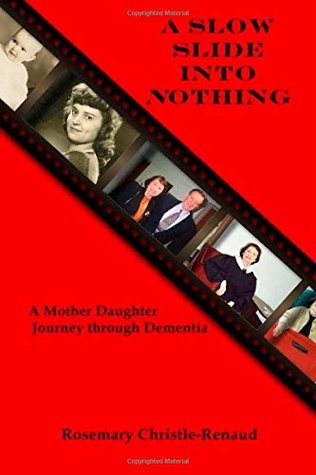
A Slow Slide Into Nothing
by Rosemary Christle-Renaud
Giveaway ends September 29, 2015.
See the giveaway details
at Goodreads.

Giveaway ends September 29, 2015.
See the giveaway details
at Goodreads.
Giveaway ends September 29, 2015.
See the giveaway details
at Goodreads.
Lately it seems, I am constantly running into people stumbling through the care of their parents. I realize there are many reasons for this phenomenon. One is of course my age. At mid 50’s most of my friends and acquaintances have elderly parents as I once did. The other is that because I went through this journey with my mother I am open to discuss the emotional ups and downs. The frustrations of dealing with uncaring hospitals and doctors, the joy of finding the perfect fit for a parent with caring doctors and nurses. And the fright of walking everyday down a path that you truly don’t want to be on. Getting a diagnosis for dementia can be heart wrenching for all involved, the parent, spouse and the child.
After Mom moved in with me, I luckily found a geriatric doctor who had established his practice based on making house calls, he did not actually have an office. Dr. C was a kind, calm man and my mother immediately trusted him. Over the course of several visits he took the time to get to know my mother, her past life and to understand my concerns. Eventually, Dr. C instructed me to make an appointment at the nearby dementia clinic. With dread, because I felt I knew what the answer would be, I made the call. The expert there concluded what Dr. C already knew. Mom was suffering from dementia. The question remained, How or should Mom be told?
Following is an excerpt from my upcoming book A Slow Slide into Nothing.
With guidance from Dr. C, we determined it was best for him to tell Mom the truth about her condition. He arrived on one of those summer days that makes me realize why I live in upstate New York. The sky was bright blue, with light green spring leaves just beginning to turn to their darker summer shades. The temperatures and humidity were at a level to enjoy the warmth of the sun and the cool breeze, as it brushed the hair from my face. I longed to be outside doing something, anything, different from what was happening in my home.
While Roxann and I gently took Mom hands, Dr. C, with his kind eyes and soft voice, gently told her she had dementia. It was brutal to watch her expression change from denial to realization. Mom asked a few questions, then became silent and eventually lost interest in what was going on around her. Roxann and I questioned Dr. C as to what we should do next.
Later that evening, Mom did not seem bothered at all by this news and the three of us avoided the topic like the proverbial elephant in the room. Roxann and I were amazed at how she accepted her fate so easily.
Mom’s reaction became apparent and heart wrenching upon Dr. C’s next visit and for subsequent visits afterwards, each time, Mom would ask him the same question. It wasn’t that she didn’t believe him, the truth was, she couldn’t remember from visit to visit what he had told her. I grieved each time along with her. In a strong voice, determined to handle her own life and the unknown, she would ask,
“What is wrong with me?”
Dr. C would answer every time as gently as he did the first: “Corki, you have
dementia.”
This has been my summer of travel. For pleasure, my husband and I took several days and meandered down the east coast, then we bee-lined across the state of North Carolina to my favorite southern lake for a family Fourth of July party. I went on a working adventure with my daughter to help her move into her new apartment before she starts law school. I discovered, while I traveled for The Scotia-Glenville Traveling Museum, the varied regions around the upstate New York area that until now were unknown to me.
During all of those hours of wandering I let my mind wonder, hoping to be inspired. To my disappointment no words jumped out of me begging to be put to print. But, a realization did occur. I have written, over the course of several years, my feelings, frustrations and the day to day surprises that helping an elderly parent with dementia can bring. Consequently, I feel it is time to share some of my words as they form into my forthcoming book.
Recently, I recalled a conversation I had with Mom on more than one occasion. This was several years before any of us suspected something was wrong with her.
“Rosemary, I seem to be forgetting things a lot.”
“Oh, Mom, that’s normal. Heck I forget things all the time.”
“Yes, but this seems to be more than normal.”
“Mom, I wouldn’t worry about it.”
Thus, I brushed her concerns away before she could elaborate more. I suppose I didn’t want to hear about anything being wrong with my mother. So I felt dismay when I recently heard a doctor on a news program say that many people know that they are having early signs of dementia. They realize something is not right. It pains me to think my Mom was alone in this knowledge and that I avoided that conversation more than once.
Eventually, my siblings and I did become aware that Mom was struggling and that something needed to be done. I recall vividly the day I entered Mom’s house to pack her suitcase and bring her to my home for what I thought might be just a long visit. It turned into so much more.
The following is an excerpt from:
A Slow Slide into Nothing
I arrived at the Indianapolis, Indiana airport, rented a car and drove to Wabash. As I pulled the car into the driveway and parked, I realized it was already warm for a day in May. I walked up the sidewalk; I could smell the fertilizer being spread on the fields just outside of town. My nose crinkled and I sucked in and held my breath so I wouldn’t smell the ripe aroma of manure in the air. When I stepped onto the porch, I expected to see Mom at the door, but, instead I had to let myself in. There she sat in the dark living room. I glanced around, remembering the salmon pink limestone fireplace that fills the wall at the far end of the living room, the family portraits, and my wedding picture. I waited for the years of childhood memories to come flooding back but they did not, could not as I looked at my mother. She looked frail, tired, and scared. Her clothing was dirty and full of stains. I was taken aback. How had Mom let herself get to this state? Mom always took pride in her clothing. She had dressed competently for her job as a high school counselor, later sternly as the city court judge. Now she wore clothing that did not match and food had dribbled down the front of her shirt. Seeing her this way was terrifying. I took a deep breath; I struggled not to appear shocked. Mom seemed embarrassed by the way she was dressed; the mess the house was in. Yet, she was unable to make any decisions or act to change it.
In a few short hours, it became apparent that Mom was far worse than I had thought. When she had mentioned on the phone she couldn’t pack her suitcase I assumed, it was not that she couldn’t but that she didn’t want to. I quickly realized she didn’t have the stamina, or the power to decide what to pack. Our past phone conversations raced through my mind, and I concluded she must have been lying to me about her lifestyle. I attributed her condition to depression about my father’s death and her forced retirement after losing her re-election as city court judge. Instead of haunting familiar places and reminiscing, I spent four days visiting Mom’s doctors, getting her car in working order, throwing out rancid food and packing. Mom sat on her bed and weakly told me which clothing she might want to pack. Most of her clothes were not clean, so I stuffed them in a suitcase knowing I would need to do laundry once we returned to my house. Just going through her medication was over-whelming. There were many duplicate prescriptions, some unopened bottles; others were empty with no replacement for them. I was frustrated trying to decide what prescriptions Mom actually needed to take and why.
Over the next few days, besieged with decisions about Mom, I was the picture of business on the outside. But, on the inside emotionally, I was falling apart. I suddenly realized that Mom was now the child and I had become the parent.
On the last day, I helped Mom climb into her packed car. We pulled down the driveway. She barely looked back. I gazed at the house I had grown up in, literally since birth, swallowed my tears, put on a good face for Mom and drove away.
 Prologue
I have been absent from my Blog for a while. In this away period I have been working on editing my book in between the call of my daily life. I am including the prologue to my book, a work in progress.
In the spring of 2007 my widowed mother left her place of birth and a lifetime of living in Indiana and moved to my home in Upstate New York. It had been apparent to me and my siblings for some time that Mom was struggling to live on her own. But, my mother’s independent streak and her fierce Irish-German stubbornness did not allow her to leave her residence of fifty years easily.
When Mom moved in with my family and me, I thought she was still grieving the death of my father, her husband of over fifty years. I had learned Mom no longer participated in the activities she once enjoyed; she rarely ventured out of her home. All signs of depression I assumed. Naively, I believed that once Mom came to live with me she would find a new direction in life from the love my family would give her. I hoped that my relationship with Mom would evolve into the nurturing, mother-daughter connection I had sought for years. Yet, after only a few short weeks it became quite apparent all of my assumptions were completely wrong.
Learning my mother had dementia, although not truly shocking, was not the ending I had in mind for our story together. Eventually, during the six years that she lived with or near me we did develop a new relationship. One I had not considered, but, still based on trust and love. Getting to that final rapport took years of struggle between us. In the beginning it was who is the child; who is the parent? Later, that trust was required to let a loving bond blossom into total faith that decisions made on her behalf were for the best.
My emotional journey also sparked a transition of my faith. My feelings about established religion had been evolving for several years. Soon after Mom moved in with me, I stopped my rare attendance at mass. My choice had nothing to do with my mother. Rather, it was a decision that had been growing within me. I felt more in touch with my idea of God when I was out in nature, or doing an activity with my friends or family. Mass became a ritual that I dreaded and consequently attained nothing from. Yet, the more involved I got with Mom’s care, the more aware I became of an inner voice guiding me. I am by character a non-confrontational person. Still, as I heard myself questioning doctors, working with insurance companies, dealing with family members and lawyers, I found the words coming from my lips sometimes were not my own. I had not thought to say them, yet there they were being said. I began to call my inner guidance my Angels. It was through this realization that my spirituality grew and I connected with these higher beings that were sent to guide and comfort me. I believe it was my Angels who first directed me to begin writing.
I did not write my thoughts down immediately upon my mother’s arrival. It was only after many months that the need to release my growing frustrations began to take shape. I joined a writing group at a local book store because I felt driven by my inner sense, what I call my Angels, to put my feelings into written word. During my first session I met a group of ladies and we formed a lasting bond that strengthened as we each transformed into writers. It was this group and our instructor that gave me the courage to record my feelings. Even then, I did not believe I would take my thoughts and turn them into the book that follows. As my writing developed, I realized my essays could be a comfort to those walking zombie like through the days of unknown dementia care and decisions as I was. Consequently, I continued in my pursuit of finishing this book not only for myself but for others who would walk down the path my mother had taken me. I hope it will bring them comfort and the knowledge they are not alone in their struggles.
To do justice to the 85 year life my mother led I have given you, the reader, a brief history of Mom’s life. I felt that was important so that you too can understand the sorrow I felt in watching this woman, who accomplished so much, slide into nothing.
The essays written about the journey Mom and I took together fall in chronological order. It is my hope that you will garner some camaraderie from my honesty, frustration, laughter, unexpected hurt and overall grief. This book is for all of us struggling together in what I call, The Caretaker Nation.
In a few short hours, it became apparent that Mom was far worse than I had thought. When she had mentioned on the phone she couldn’t pack her suitcase I assumed, it was not that she couldn’t but that she didn’t want to. I quickly realized she didn’t have the stamina, or the power to decide what to pack. Our past phone conversations raced through my mind, and I concluded she must have been lying to me about her lifestyle. I attributed her condition to depression about my father’s death and her forced retirement after losing her re-election as city court judge. Instead of haunting familiar places and reminiscing, I spent four days visiting Mom’s doctors, getting her car in working order, throwing out rancid food and packing. Mom sat on her bed and weakly told me which clothing she might want to pack. Most of her clothes were not clean, so I stuffed them in a suitcase knowing I would need to do laundry once we returned to my house. Just going through her medication was over-whelming. There were many duplicate prescriptions, some unopened bottles; others were empty with no replacement for them. I was frustrated trying to decide what prescriptions Mom actually needed to take and why.
I have been thinking lately about decisions I made for my mother. During my day, I often run into people who are in some stage of being a caretaker for a parent. Some are in the beginning stage of denial. Some are in the panic stage of, what do I do now? Others are in the end stage and either silently, or out loud, are praying for an easy death of their parent. I recognize all of these stages, because, I experienced each one.
As I’ve said before, I don’t mind listening and giving advice when asked. Sometimes the obvious is very clear to those looking in, but not clear at all when you are the participant. Recently, I heard of a woman who was trying to work full-time and take care of her mother, who lives alone. Not only does she live alone, but she cannot cook for herself, can’t get herself to the bathroom, can’t get herself dressed, the list continues. Yet, this loving daughter is trying to figure out how to take care of her mother without bringing in extra help or removing her from her home. As I write this, the situation sounds very obvious as to what needs to be done. But, put yourself in that role and all kinds of emotional problems surface. There are promises made: Mom, I won’t put you in a nursing home. Of course I will always take care of you. There are financial issues that come with many questions. Can my parent pay for care? What if my parent refuses to pay, but I need the help? Can I take over financial control?
Personally, the most important conclusion I came to, after taking on the role of caretaker, and spending months becoming more and more stressed was to realize, I can’t do this on your own. Struggling, without admitting you need help, leads to problems later. I found, reaching out to others in the same situation helped me tremendously. As I entered my caretaker role, there were others in the midst of it. These people understood the ends and outs. They were aware of doctors, facilities, and organizations that could help with guidance on what to do and what help was available. They knew tricks on how to just get through the day. For many women, and I say women because the caretaking generally falls to us, the decision to admit we need help can be covered with guilt. But, guilt should not be involved.
As a caretaker, your first step is to take care of yourself. If you fall ill or get hurt, then everyone is in trouble. Bringing in help; taking hours, days, weekends off is not selfish, it is putting your role as caretaker first. When you are rested then your patience comes easier. The skills needed to handle your tasks flow smoothly.
The worst day of my life, and I can also say for my sister, was the day we took our mother to an Assisted Living Home for Dementia Patients. Like many of her generation, Mom had a pre-conceived notion of a “nursing home”. It took us hours to get her out of bed, dressed and into the car. I still get emotional when I think of that day. But, and this is huge, our mother grew to enjoy her new home. She found she liked the independence of being out from under my control. She made friends; the staff grew to love her. As for our relationship, it returned to more of a mother-daughter one. Since I was no longer trying to get her to take her medication, to bath, to eat, to go to sleep, to get out of bed, we could enjoy each other. I took Mom out to lunch, we got her nails done. She came to my house for holidays. When she no longer felt comfortable doing those outings, we did puzzles and watched TV.
Looking back, each day seemed endless at times. But, now I know, making the most of what time is left, and providing the best care, is essential. Even if it means letting that care come from someone else. Asking for and excepting help are all part of a good caretakers role. In the end, the decision to let go of some of my control was the best one I made as a caretaker.
I watched parts of the Republican Convention, and I am watching the Democratic Convention this week. As a woman, it seems to me; both parties are working hard to get my vote. In my opinion, that is a good thing. Women of this country have the capability to make change. We are lucky to live in the United States where that statement can be true. Yet, many times, as the caretakers of our families we get so caught up in managing our own concerns we forget to notice what is taking place in the country and world around us. Many of the decisions that will be made in the coming years will affect how we live. The decisions will also affect how our children will live. Consequently, the women of this country need to stand up and take control of the political environment. If the parties are going to work hard for our vote, then we need them to work for us. The issues we find to be the most important, should become front and center in the political debate. And, men should not be the only ones in that debate.
Many times when I talk with younger women, I hear an unrecognized understanding of how close they are to the change that has recently taken place for our gender. 20 and 30 something’s never lived in a time when Title 9 wasn’t there for them. They don’t fully comprehend what a glass ceiling is. The idea of deciding a major for college based on your interests is natural for them. They did not need to take into account that there were careers not meant for a woman. I am thankful our daughters can have these thoughts. But, we must not let our hard won victories come undone by complacency.
Today, I am asking all women, young, middle-aged or old to take notice of what is going on in our country, politically. Take a stand, voice your opinions; if not to neighbors and friends, then with support of the candidate of your choice. Women are often the catalyst for growth in their families, take that initiative one step further and work for growth in our country. Even if that means just voting.
 Rosemary Christle-Renaud